
Exciting treaty between EU and China
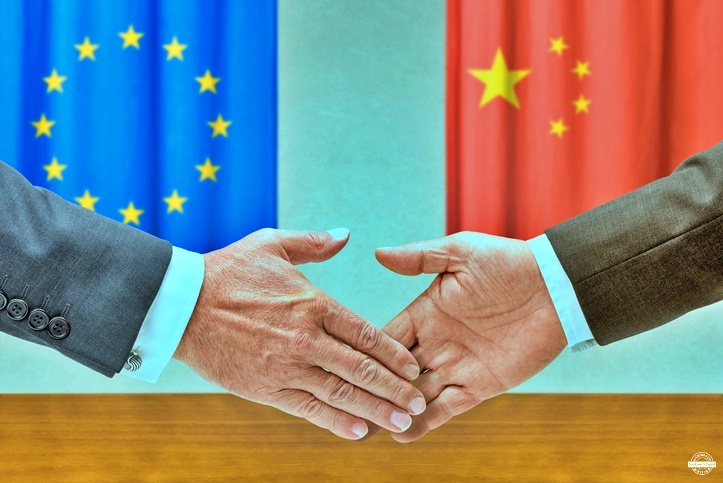
Towards the end of 2020, EU and China negotiated a remarkably interesting agreement. The investment treaty came into place in the shadow of a fiercely accelerating Covid-19 pandemic in Europe, as well as the year-end in general. Despite seven years of negotiations, the agreement has so far not received much attention, but for several reasons, a debate will most likely emerge.
The start of the negotiations was, as mentioned, a number of years back. At that time, there was a different battle about China between the EU and the US. Therefore, the two Western economic heavyweights did not get along, but would each negotiate their own agreements with the “Kingdom in the Middle”.
Over the course of seven years, much has changed, and the Western political view on China has moved. The US and the EU are currently trying to find a mutual standing on China, in addition, the new treaty between the EU and China must first be approved within the EU. I have no doubt that the ratification process means that the agreement will be discussed in detail across the EU. How much it will mean for the agreement and whether it will be delayed, can only be guessed about. However, the agreement itself is worth spending time on, as it contains many exciting elements that will be of big importance to European companies that are already present in China, or have a desire to try their luck in the big country.
The agreement is not a free trade agreement, as it is more operational, but the agreement opens up for significantly more equal conditions of competition for European companies active in China. The agreement replaces 26 agreements with EU Member States (excluding Ireland), and therefore the agreement gives the impression of regulating some areas that are normally regulated in a free trade agreement. Some compare the agreement with the “Phase 1” trade agreement that outgoing US President Trump negotiated in place with China.
In another area, the EU is given the same conditions as the United States, namely within financial services. This means that European financial companies, as well as insurance companies, are no longer subject to any joint venture requirements and moving forward, there will be no maximum for the equity that European financial companies can allocate to their Chinese operations.
An intention of the agreement is also to deal with unfair competition in the Chinese market, where Chinese companies that are fully or partly owned by the state are often favoured when competing with foreign companies. Another important change involves transfer of technology, where European companies have been demanded to transfer technology to the production sites in China, though this is now abandoned.
The service sector will be opened for European companies, so they can access the Chinese market in a completely different way, though this does not change the already tough competition that many European companies will face in China. Perhaps European companies in the healthcare sector find the agreement interesting, as healthcare is mentioned. I think China would be interested in increased activity from European companies in this sector.
It is said that a good deal is a deal where both parties are satisfied with the outcome, but what’s in it for China? The Chinese companies will be allowed to participate more in the European market for sustainability, green energy, renewable energy, etc., however, with a maximum investment per EU member country, and China must open up the same scope of business the other way around. China gets some more openings in the European markets, probably also within digitization, though I have only briefly seen this mentioned in Chinese reports, and it requires a closer look.
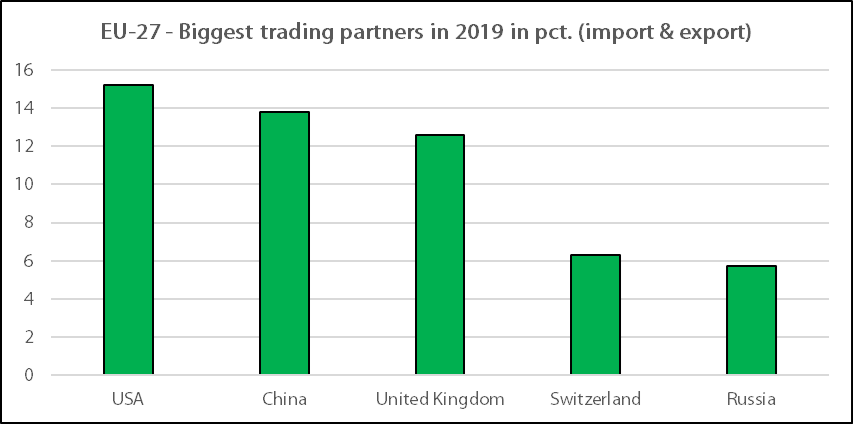
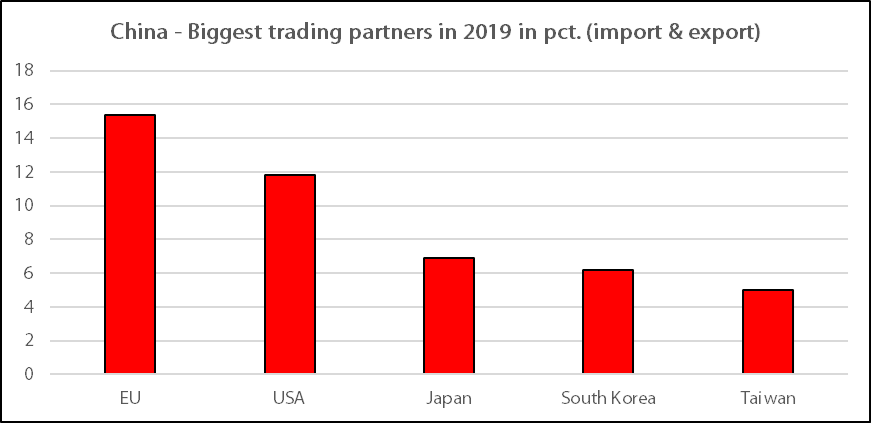
Some may think that EU got many demands negotiated through, and I agree that this is the case. My assessment is that for China, the agreement has a very high immediate diplomatic value, as well as a strategically important significance. To take the latter first, the two graphics clearly show the very large trade relationship between EU and China. The mutual investments into each other’s economic zones, on the other hand, are quite limited, when one considers the size of the economies. To ensure a closer link between the two regions and also diversify the economies, more bilateral investments will certainly have a strategic positive impact.
Undoubtedly, China was ready to give in on quite a few areas to get another diplomatic trophy home before 2020 ended. It should not be forgotten that in 2020, China also entered into a free trade agreement with Japan and the ASEAN countries. However, I would describe that agreement as a Version 1.0, but the Asian free trade agreement has great strategic value, also to secure trade for China.
This is also how I assess Beijing’s view of the agreement with the EU, and moreover, the agreement comes at the same time Joe Biden is set to take-up up the position as new President of the United States. Therefore, there is political explosiveness in the agreement in both Europe and the United States, though this does not change the fact that the agreement will be quite exciting for European companies. Very interestingly, the agreement, in reality, encourages European companies to invest into China and generate new jobs in China…