
Philippine economy out of the woods
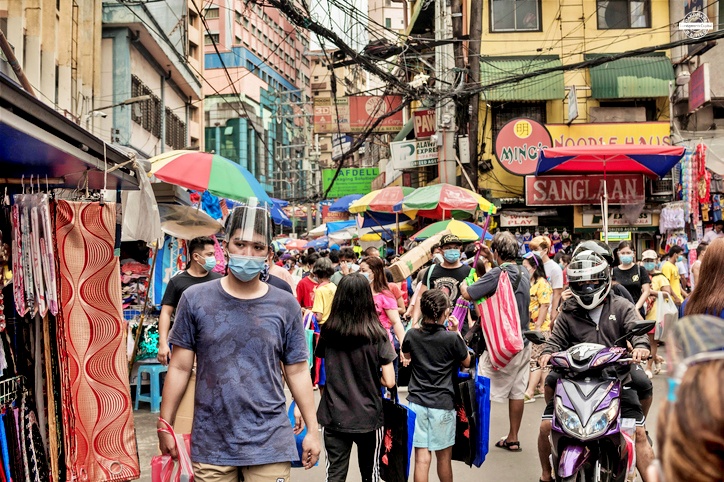
Many economic crises typically start steep downwards, or alternatively, the speed increases as the crisis progresses, but no matter how an economic crisis develops in general, it is associated with a good portion of fierceness. Many will remember the fierceness of Covid-19 crisis and where the acceleration of the crisis happened in several dimensions at the same time.
The way out of a crisis is well known, as it is normally rocky and uphill, though from a global perspective, there are now some bright spots developing on the rocky way out of the Covid-19 crisis.
In the financial markets, it has been, in my view, realistic for some months to consider the time after Covid-19. Much will still depend on how individual countries continue to be affected by the virus, or conversely, how well they manage to keep the virus under control, until a vaccination is well underway. Based on the latest updates from some of the major pharmaceutical companies, more vaccines will most likely be released in the middle of the first quarter next year. In my opinion, this is reasonably in line with the expectations that is priced in the stock markets. If these expectations are met, I can imagine that the world will start to breathe a sigh of relief in the middle of 2021. However, in certain parts of the world, people are already in the “period after the Covid-19 crisis”.

Many countries in Africa have done well through the pandemic, but the continent represents approximately three pct. of the world’s total GDP, therefore, Africa cannot save the global GDP growth, but it has long been expected that China’s economy would move forward very quickly again. China, after all, represents approximately 15 pct. of global GDP, so the returning growth in China has, as a minimum, significance in Asia, especially in the core Far East.
It also helped German car manufacturer BMW, who for the third quarter, presented a historically high quarterly turnover. Car sales in the Chinese market exploded with an increase of 31 pct. compared to the third quarter of 2019. Of course, the increase is caused by many car buyers who postponed their purchases until after the Covid-19 crisis, thus the situation is now largely considered as “post-crisis” in China. Consumers have returned, also in the restaurants, and it has been possible to go out again in Wuhan since May, but in the now famous city, the atmosphere has been subdued. From what I hear, it is only lately that life in cafes, bars, and restaurants have become more relaxed.
China’s economy on its way back in a higher gear is also reflected in China’s imports, which have risen since May and significantly in September. There have been indications that this increase in economic activity has also been felt in China’s neighbouring countries.
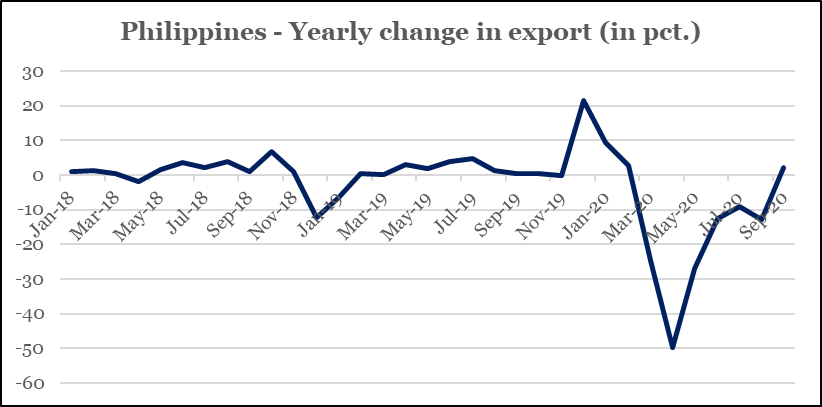
On the 4th November, the Philippines announced its September trade data and this reading contains bright spots. Graphic one shows the annual change in the Philippines’ exports in pct. that of course had a big decline in March, when the Covid-19 began to rock the world. Conversely, exports relatively quickly found a way back, though still with negative yearly growth rates compared to 2019. Exports in August gave cause for concern, as the negative annual trend found momentum again, but in September, exports jumped and are now showing a positive increase compared to September the year before. It should perhaps be mentioned that the large rate of increase at the end of 2019 has a technical explanation, as it is related to the negative development in the autumn of 2018 (a decline due to the trade war between USA and China).
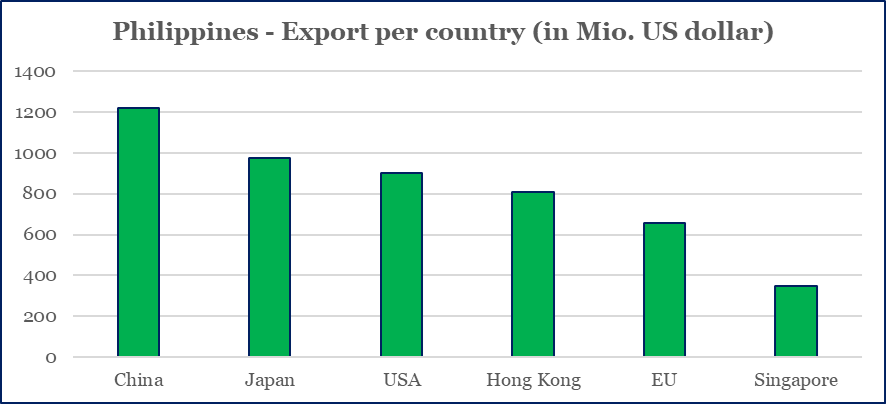
Looking at graphic two, it is clear that the export growth to the Chinese market (also combined with Hong Kong) is making its high mark in the export statistics. Approximately two years ago, there was a time when the EU was the largest export destination for Philippine producers, but China has taken over that position, and I have long considered when the current progress in China would be noticeable in economic growth among China’s neighbours. September’s trade data is an example, and the progress is found primarily in the sectors where Philippine companies are subcontractors to Chinese factories, like producing components for the electronics industry.
These are bright spots for the Philippine economy and indications of a way out of the economic crisis following Covid-19, though it is a rocky, long, and difficult way, but other areas of the Philippine economy are also moving forward. The closure of the country has varied from province to province, with the capital Manila being hit hard. But here too, normal life is returning with the restaurants welcoming patrons again and with bars only closing at midnight.
Of course, the overall progress in Asia is fragile, and if the countries are hit by a new Covid-19 wave, then it will mean a setback for the respective countries. That risk will be there until vaccinations are widespread, but the trade figures are another example of Asian economies now starting to take the rocky path out of the crisis, which is obviously interesting for investors.