
2020 markets take-off from the top

Teaser: Between Christmas and New Year, the US stock market rose to new record highs, which also pulled up some European stock markets, thus touching old records- this could represent a challenge this year.
2020 kicks off with a Brexit that is now finally becoming a reality. I consider it positive that the UK has made an irreversible decision, no matter what it looks like. The fact is that the shot can still go in all directions in terms of how the outcome of a Brexit deal will be, or if there will be a Brexit agreement at all, this may well cause uncertainty during the first six months of 2020.
However, I expect that even the corporate sector will settle with the uncertainty and thus regain the forward-looking focus, and at the same time, I expect that the UK government will do much to stimulate domestic demand. At best, the result will be a stabilisation of the UK economy, especially during the second half of 2020. This development is currently my primary scenario and also why I argue that the “Brexit risk”, so far, is manageable. But it is Europe that will become the hub for investors’ concerns and uncertainties in 2020.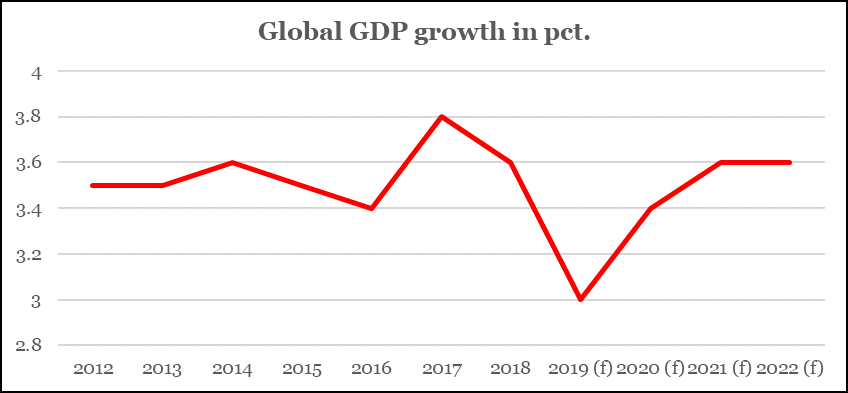
If one trusts in the predictions of the International Monetary Fund (IMF) as shown in graphic one, then 2019 became the year with the lowest global GDP growth since the global financial crisis. At this early start of 2020, I share IMF’s optimistic outlook for 2020, since some tailwind should come from the de-escalation of the US-China trade war, the Brexit has found a direction, and additional growth in several countries due to increased fiscal spending.
But many economists have the opinion that Europe will have another year of very low growth, and it is no secret that I share that position. The same growing number of economists, as well as financial market participants, also express scepticism about ECB’s monetary policy. There is a chance that the central bank would prefer to change its monetary policy position, but it will be a difficult task for the ECB to signal a change in the monetary policy given the weak economic growth running in the background. Just to mention, by a “monetary policy change” at the ECB, I do not mean a rate hike in 2020, but a message that the next step will be a rate hike, which could be in 2021.
If the ECB should go for a change, and aim at a successful timing, then some global economic tailwind is needed and the increased European fiscal stimulus must work, or alternatively, even more public investments should be announced. I regard it as very likely that both the internal and external scepticism about ECB’s monetary policy have reached a level where it’s difficult for the central bank just to maintain the same rhetoric throughout 2020. My best bet is that at the press conference on 16th July, the ECB will change its rhetoric as it prepares the market for a new direction in the monetary policy, however this could also happen in June.
On the other side of the Atlantic, it would surprise me if US President Trump can push the American central bank towards more interest rate cuts, which means that a definitive change in global monetary policy is taking place (excluding Japan). Consequently, my position is that this year, the bond market will start to face tough times.
It is important to note that I expect dropping bond prices simply express a shift in the yield curve, i.e. adjusting to the fact that central bank rates are set to rise again at some point, which all bond prices will adjust to. Graphic two suggests that this already is happening in the US bond market, despite the interest rate cuts from the US central bank during 2019.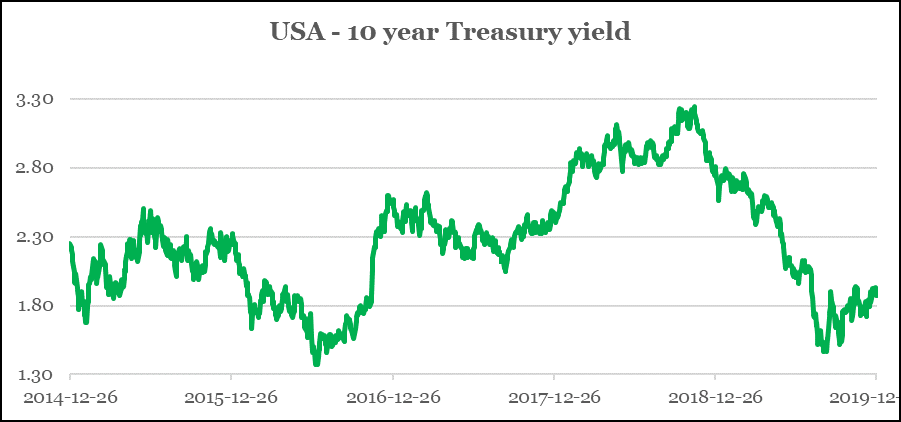
I expect the coming move in the bond market to be a correction, and not a new bear trend which for example would require rising inflation, though that particular risk is not relevant this year. Also important to notice, is that I am still not worried about any significant widening in the credit spread during 2020, though the concern about poorer credit quality will become a major theme later this decade, maybe in 4 to 5 years.
2020 will also be a year when politics will once again affect the financial markets. It’s not necessarily the US presidential election, as it is pretty much on the financial market’s radar screen. But perhaps not everyone has noticed the new troubles that are emerging for the Italian government, like when the Italian Minister of Education Lorenzo Fioramonti announced his departure during the Christmas days. This can happen, and it is a hard blow for an Italian government operating on a particularly weak foundation, and with the EU sceptic Matteo Salvini just waiting to get back into power.
In that Italian game, the regional elections in Emilia-Romagna at the end of January may play a central role, and risks to intensify the debate about Italy’s future within the EU. If that would be the case, it will happen in a political context in the Eurozone, with a German government that remains incapable to govern, and a French president whose biggest project now is to raise the future retirement age, like for the railway staff.
The “high” that a number of European stock markets take off at, I consider as the biggest challenge in the financial markets if I look at the whole year, and not just focus on the possible optimism in this year’s first half. Of course, it is not only the actual level of a stock index that expresses if stocks are cheap or expensive, but also a range of other key figures belongs to the picture. Based on the current mix of price level and key numbers, I argue that several European stock markets are approximately 20 to 25 pct. more expensive than a number of Far Eastern stock markets (excluding Japan). Whether the Far East will rise or Europe should decrease during 2020 is a good question, but as the momentum is right now, it seems more likely that Far Eastern markets are catching up instead of Europe dropping by 15 to 20 pct. – and it’s quite deliberate that I mention Far East and not “Asia”, as India’s stock market in particular looks like a real peak.