
More risks from Emerging Markets

Teaser: During the first 10 months of the year, investments in Emerging Markets have generally been a loss-making experience. Most times, a market turns around, though in this case, it still requires a few months of patience – and risk appetite.
The Argentine Peso has lost half its value to the dollar, the South African Rand was under pressure during the year, and the economic earthquake clearly hit Turkey, which has so far resulted in a 25 pct. rebate on the country’s currency. Graphic one shows another example with the Philippines as one of the countries that “forgot” to hike interest rates when the U.S. started to tighten the monetary policy. But investors didn’t wait, and instead fled from the Philippine bond market, which was hit again when the Philippine central bank had to raise interest rates quite aggressively around August. Yes, the losses were significant, but from this look-back on the year so far, what is notable?
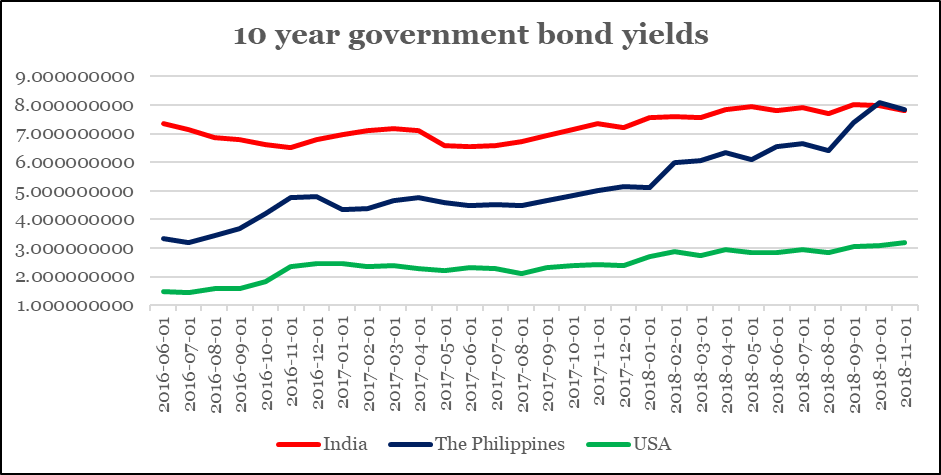
Surely, the United States is the biggest dash in the cocktail, because of the rate hikes and the country’s importance. But seen in a global perspective, and with deep respect for the countries mentioned, it is actually smaller economies that have pulled bigger headlines and have made Emerging Market investors suffer.
The expectation of rate hikes in the U.S and the general nervousness in the financial markets made me argue for rising Emerging Markets risks throughout 2018. But what if the turbulence become even bigger in the big Emerging Markets countries such as Brazil, India and China, instead of cooling-down as many investors hope?
Quite right, China is hunted by President Trump with his import tariffs that will affect China’s GDP growth to some extent, and the Chinese stock market has surely already priced all the bad news in. Nevertheless, it should not be underestimated that the Chinese government continues its efforts to reduce the domestic debt pile which is a de facto deleverage of the economy. This action will slowdown growth, though I regard it as healthy, as long as the slowdown is due to debt reduction. To counter the economic headwind, the government has implemented a pretty extensive tax reform, which is positive. My assessment is that it cannot outweigh the slowdown related to the reduction of debt. All in all, China’s GDP growth can therefore drop to 6 pct. faster than expected.
I wouldn’t be worried about the development, but the whole world seems to suffer from a basic “China fear”, where each negative headline is perceived as China could go under – but a sudden drop in growth may occur at a very unfortunate time if it collides with challenging news from other emerging market economies, like within the next three to six months.
A completely different, though deeper concern is the dispute between the Indian government and the country’s central bank, Reserve Bank of India. If one has or wants Emerging Markets exposure in the investment portfolio, I think the battle is worth paying attention to. The very short version in my opinion, is that the government is trying to increase control over the central bank.
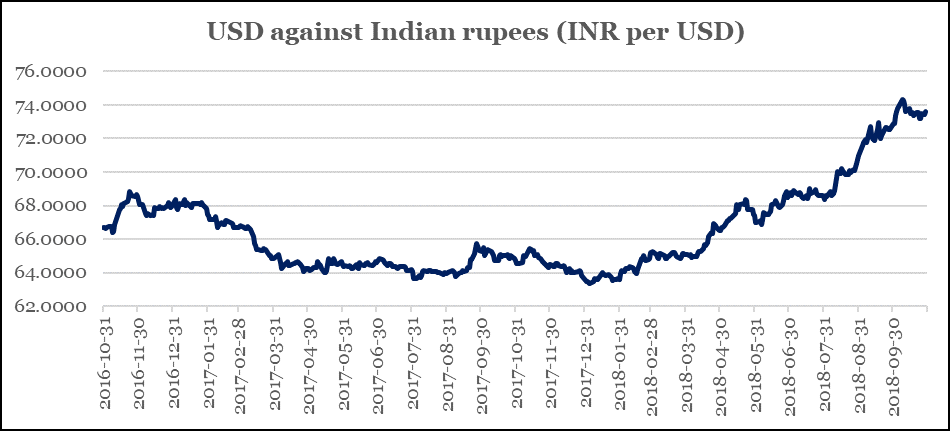
It should be remembered that the same situation got the last foreign investors to leave Turkey earlier this year. India’s government should not neglect that the country needs capital inflows due to its notorious external and budget deficits. The Indian bond market has remained fairly stable (graphic one), but dollar-based investors have lost 15 pct. on the currency so far this year, as graphic two shows.
In Brazil, a new president has just been elected, and thus also a new government. No doubt that Emerging Market investors will get to know the name Paulo Guedes, as it is Brazil’s new finance minister. He is strongly inspired by Milton Friedman, with a liberal approach to trade and economics as a whole. Compared with the policy of the former government, it is the diametrically opposed direction, but regardless of whether reforms are considered good or bad, they can give turbulence for a period of time.
Another important factor for investments in Emerging Markets is the currency risk, where the good news after the big currency losses this year is that the bottom has come closer. I have seen quantitative / economic models indicating that Emerging Market currencies are extremely cheap. Some models express it as “lowest since decades” and others quantify that the market is now two standard deviations away from the median, which is extremely much.
With the models, I partly agree, but I am not quite that optimistic, because the affected economies also will have a hard time during the coming years. In addition, the American monetary policy tightening cycle continues for another 18 to 24 months, and lastly, there will be less global growth to help a groggy Emerging Market economy recover.
It all sounds very serious, and I do not think one should underestimate the risks, but brighter times will come. Right now, some macroeconomic growth forecasts are getting downgraded, but I estimate this is already largely priced in the financial markets. Basically, I do not asses the global economy as it’s about to flush out. If the world economy is shaky, then the dive would have happened for about twelve months ago when Trump threatened almost the whole world with a trade war.
The Emerging Market countries that are hit the hardest this year will also remain economically wobbled in 2019. This is one reason why I have argued that the Emerging Market nervousness can drag out this time. Further, I argue that Emerging Markets countries will feel the heat once more in the first quarter of next year, when the focus returns to how many times the U.S. central bank will hike interest rates in 2019.
Since the beginning of this year, it has been my overall picture that the first quarter of 2019 is the time to increase exposure in Emerging Markets. As everybody knows, timing in the financial market is everything, though at the moment, I maintain the assessment. The developments in India, and possibly in Brazil, are new factors from the past couple of months. These factors are potential growing challenges, though if they escalate, I expect that it will happen within the next few months. All in all, I still see the Emerging Markets risk as increasing, with a large likelihood of further losses, but the time to increase exposure remains to be in Q1 2019.